Next Round I'm Bringing My Own Knives. Watch Me Cook.
Three minutes, no laptop, and one very nervous founder at a pitch day called KitchenPitch


I once fixed production at 4 a.m. while my boss was on a call with investors in the US, patching it live underneath a demo that could not be allowed to fall over, and my hands were perfectly steady the whole time. Put me on a stage for three minutes with no laptop and a clicker someone else is holding, and my hands stop being mine. That was me this week at KitchenPitch, FreshMango's pitch day, halfway through the program, running on a long drive and service station coffee that made me alert without making me competent.
A pitch is a deck, not a demo. Three minutes, a timer, slides on someone else's machine, and nothing live to hide behind. Turns out that's a gift, because it forces you to say the thing out loud instead of pointing at a terminal.
Which is the interesting problem with pitching infrastructure. What you're selling is an absence: no surprise invoice, no 3 a.m. page, no afternoon lost to a YAML file that lints clean and deploys the wrong thing anyway. You can't screenshot an absence. You have to put the pain back in the room before anyone cares that you took it away, and that constraint made me a better explainer in a week than a year of writing docs did.
What I actually said
My first version of the one-liner was written by an engineer, which is to say it was full of words like deterministic, graph model, and provider-agnostic. Every one of them is accurate. None of them mean anything to a room that has thirty seconds to decide whether to keep listening, and they're impossible to say out loud with a dry mouth.
The stage version was just the platform. Push a branch on GitHub, get a static site, a container, or a managed PostgreSQL database, with a preview environment per branch and pricing that scales to zero when nobody's using it. Deploy without learning VPCs, subnets, security groups, and IAM roles first. That part runs today, so I can answer hard questions about it without saying "eventually" once.
I would love to tell you it came out clean. It did not. I got about four words in, tripped over "PostgreSQL", said the first half of it twice, and heard my own voice do the thing where it belongs to a nervous stranger. PostgreSQL is a perfectly good word to type. Out loud, on a timer, it has too many syllables and all of them turn up at once.
I rehearsed eleven times. Twice to an advisor, once to a bathroom mirror in a building I don't work in, and twice in the car to a paper cup of coffee that had no notes.
You can't demo an absence
A good infrastructure demo is one where nothing interesting happens. Deploy works. Bill stays small. Preview URL loads. Thrilling.
So I opened with the receipt instead: a $4,847 AWS bill for an app doing about ten thousand requests a day. Nobody needs to know reserved instance math to get that ratio. Slide two was the 14 hours I lost to a service mesh race condition that would only say context deadline exceeded, in three components at once. A few people laughed. A few looked away, which is the reaction I want, because it means they've been there.
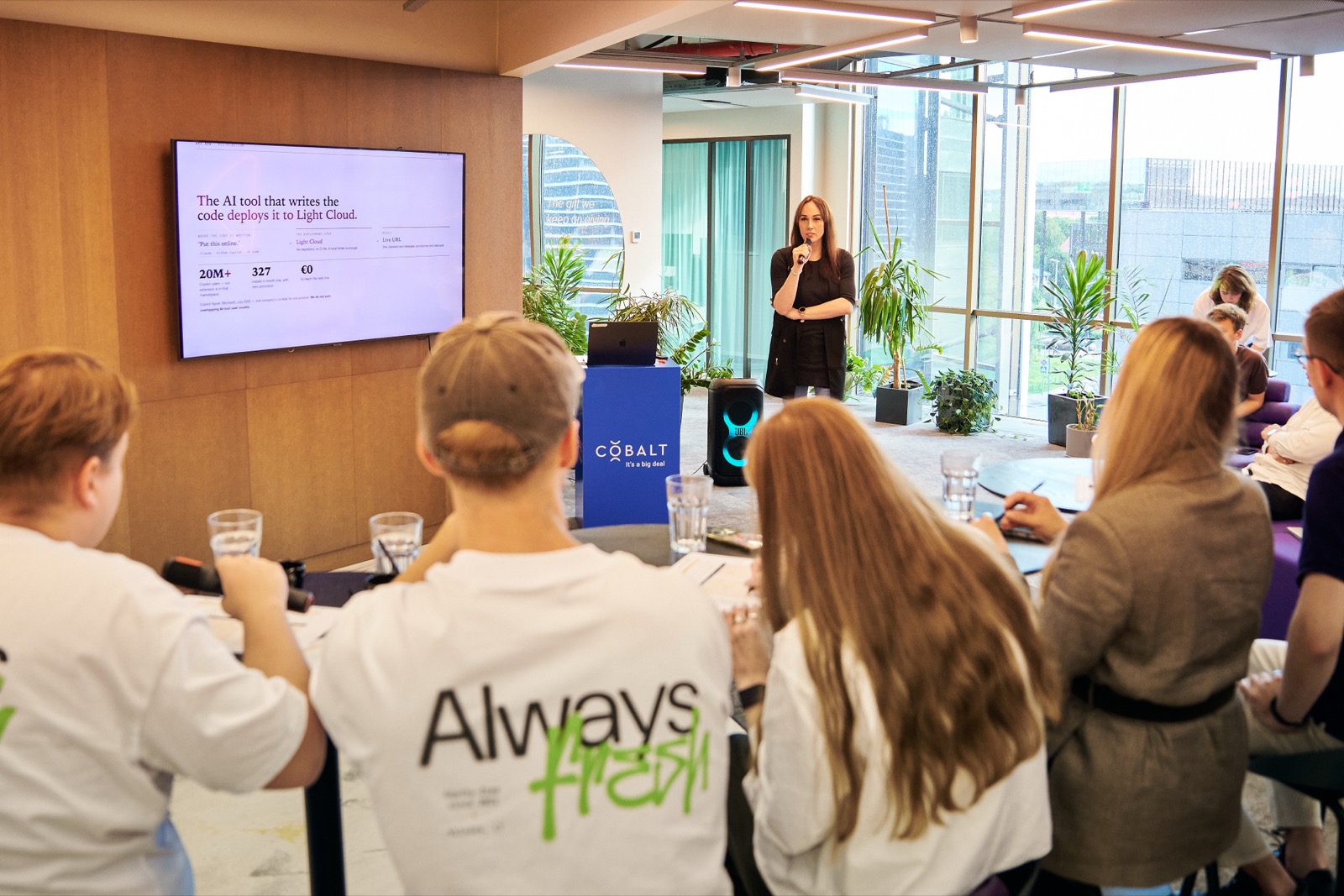
Somewhere in minute two I stopped hearing my own voice. I'm calling that flow state and not the coffee and the motorway arriving together. It worked. People came to find me afterwards, which is the only metric a pitch day really has.
The part I left out on purpose
ICE never made it into the deck. The Integrated Cloud Environment is the desktop app we're building: architecture, infrastructure, and code in one place, with a graph model underneath that spans AWS, GCP, and Azure and tells you when what's deployed has drifted from what you meant. Visual Studio, but for cloud infrastructure. That's the line I've been sharpening for months, it's why I started a company instead of writing another deploy script, and it's the slide I most wanted to show.
I cut it anyway. Three minutes fits one new idea, and mine went to the platform that already runs. You get to pitch the future after the present survives questions. So ICE stayed out of the deck completely, no teaser slide, no mention. It gets its own twenty minutes with a whiteboard and no timer, once there's something to show.
The hedging went too. Early drafts had "we believe" and "we're exploring". A one-person company with three advisors gets no points for sounding institutional. The platform runs, ICE is in development, and that's what I said afterwards by the coffee, once my hands were mine again.
My face recognition was still down, though. I looked straight at the accelerator's CEO, a person I know perfectly well, and my brain returned nothing. No name, no context, just a friendly face and total silence from the lookup. In my defense, at that point I wouldn't have recognized my own mother, and she's the one who redesigned container orchestration with Tupperware.
Worth the drive
A deck ships nothing, and eleven run-throughs plus the drive cost me a day my deploy pipeline definitely noticed. I'd do it again this week.
But that one-liner isn't a slide. It's the sentence I'll say a few hundred times now, to investors, to candidates, to whoever asks what I do while the espresso machine takes its time. Getting it wrong in a friendly room in September is free. Getting it wrong in a first investor meeting costs the meeting.
And the room asked better questions than my own notes did. That's the part of FreshMango I didn't expect. The mentors they bring in have actually run things, so the feedback lands on the argument rather than the font size. One of them sat down with me after the event and went through the deck slide by slide, and the version I'm taking into investor meetings is noticeably better than the one I pitched with. That kind of help is hard to buy and easy to underrate.
The nerves were smaller than last time. Not gone, smaller, and that's the trajectory I care about. Speaking to a room is a skill like any other: it responds to reps, and I have spent my whole career avoiding the reps.
What I took home is that explaining infrastructure without a terminal is the same job as building infrastructure people can actually see. Three minutes forced me to find the sentence. ICE gets its slide when ICE is ready to be seen. The event is called KitchenPitch, my mom once explained container orchestration with Tupperware, and I served three minutes without a laptop and got seconds asked for. The kitchen theme is holding.
Next round I'm bringing my own knives. Watch me cook.
More articles

The Metrics We Actually Track at Pre-Seed
Every pre-seed deck leads with a growth chart, and most of those charts are statistical noise. Here are the numbers we actually watch: time-to-first-deploy, activation, and gross margin per workload type, and why.

Security When You're a Two-Person Infrastructure Company
Can a two-person company be trusted with your production workloads? That question deserves specific answers instead of vibes. Here's our threat model, what's done, and what honestly isn't.

Cloud CPR: A 5-Step Resuscitation Program
People keep asking about our roadmap. Investors want timelines. Beta users want features. My therapist wants to know why I twitch every time someone says 'scope creep.' So here it is-five steps from scrappy MVP to enterprise cloud domination, complete with the delusion, optimism, and questionable life choices that got us here.
 Julia
Julia